

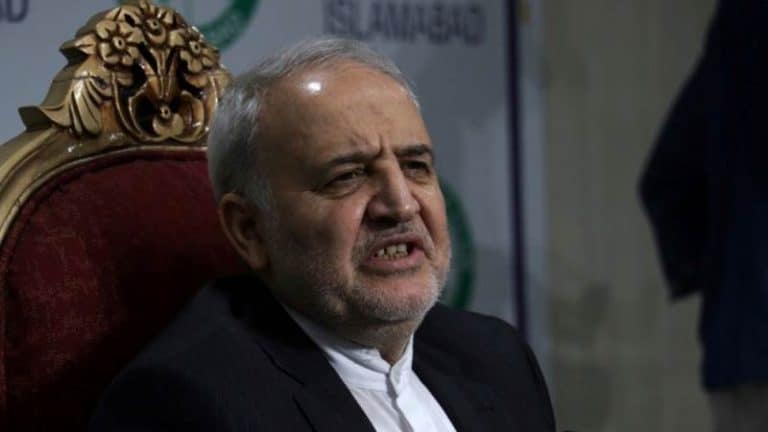
Reza MoghadamIran’s ambassador to Pakistan, Reza Moghadam
Iran’s ambassador to Pakistan, Reza Amiri Moghadam, on Wednesday dismissed claims of ongoing negotiations between Tehran and Washington, contradicting remarks by US President Donald Trump suggesting progress toward ending the conflict.
“We have heard such reports in the media, but according to my information, no direct or indirect talks have taken place so far,” AFP quoted the envoy as saying.
He added that while friendly nations often attempt to mediate, there was no concrete engagement between both sides, describing current hostilities as “illegitimate aggression.”
Echoing the ambassador’s position, Iran’s military also rejected Washington’s assertions of diplomacy.
Spokesperson of the Khatam al-Anbiya Central Headquarters, Ebrahim Zolfaqari, said the United States was effectively “negotiating with itself,” according to state media.
He warned that regional stability would remain tied to Iran’s military posture, stressing that pre-war economic conditions would not return unless Washington altered its approach.
Amid the diplomatic row, fighting intensified across the Middle East, with Iran launching a fresh wave of missiles and drones early Wednesday.
According to Iran’s Revolutionary Guards, the attacks targeted Israel as well as locations hosting US forces in Kuwait, Jordan, and Bahrain.
Air raid sirens were reported across central Israel, with missile trails sighted over Netanya.
In Kuwait, a drone strike hit a fuel tank at the international airport, sparking a fire, while Jordan confirmed falling debris near Amman. Bahrain also activated its air defence systems in response to the threat.
The conflict, which began on February 28 following coordinated strikes by the United States and Israel on Iran, has since spread across the Middle East, destabilising a region already under strain.
Gulf nations, once seen as relatively stable, are now facing growing security risks, with tourism and aviation sectors heavily impacted.
The violence has also spilled into Lebanon, where Israeli forces have intensified operations against Iran-backed Hezbollah. Authorities say over 1,000 people have been killed, with more than a million displaced amid widespread destruction in Beirut’s southern suburbs.
Despite Tehran’s denials, Trump insisted that negotiations were underway.
“We are in negotiations right now,” he said, claiming Iran had offered a “very big present” linked to the strategic Strait of Hormuz, though he provided no further details.
However, there has been no official confirmation from Iranian authorities to support the claim, even as reports suggest possible backchannel diplomacy involving intermediaries such as Pakistan.
Meanwhile, the United States is said to be preparing for further escalation, including plans to deploy additional troops to the region.
The Strait of Hormuz remains a critical flashpoint in the crisis, given its role in global oil supply.
Iran, in a communication circulated via the International Maritime Organization, assured that “non-hostile vessels” would be allowed safe passage.
However, it warned that ships linked to what it described as “aggressor parties”, the United States and Israel, could be denied access.
The disruption has already rattled global markets, prompting countries to cut energy consumption and forcing airlines to reroute or cancel flights.
The broader economic implications of the conflict are beginning to emerge.
A senior official of the World Trade Organization, Jean-Marie Paugam, warned that supply disruptions, particularly in fertilisers, could have long-term effects on global food production.
“If fertiliser supplies are affected, it will impact both output and prices, with effects carrying into future harvests,” he said.
Despite tentative signals of diplomacy, the sharp divide between Tehran and Washington, coupled with escalating military actions, continues to fuel uncertainty across the Middle East and the global economy.