

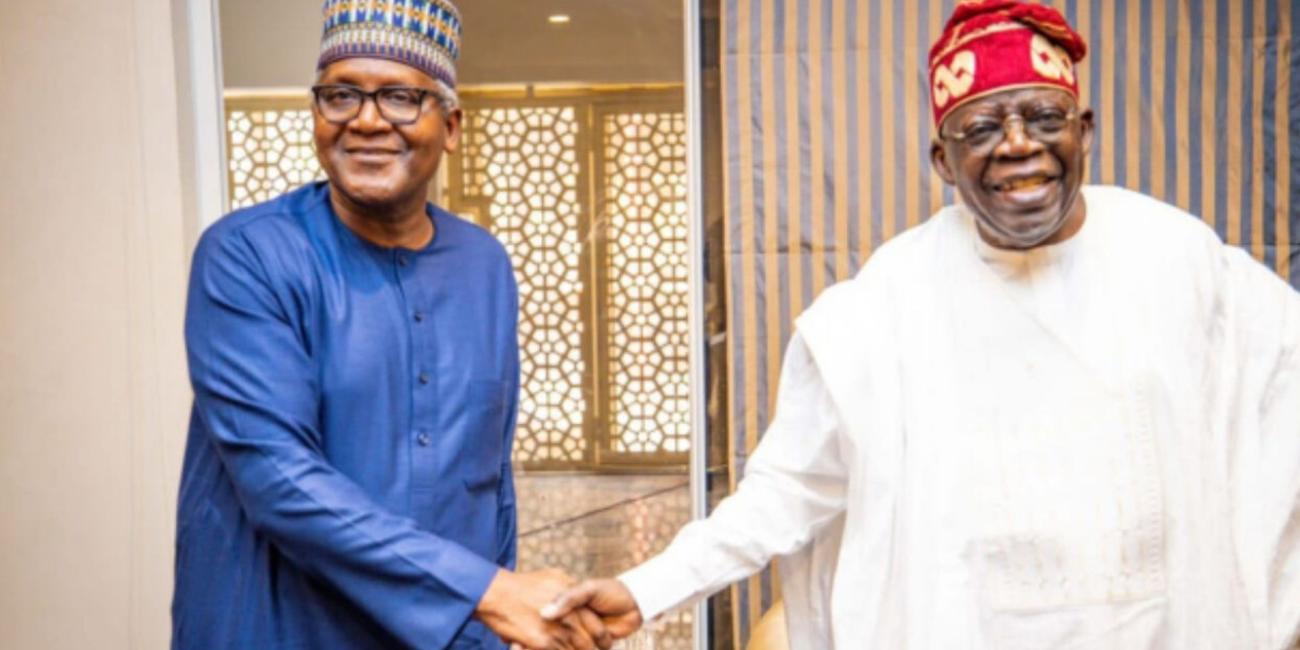
Speaking after a visit to President Bola Tinubu in Lagos State on Monday, Dangote highlighted a critical consequence of prolonged oil market volatility: governments may be unable to cushion citizens through salary increases, even as living costs rise.
President of Dangote Group, Aliko Dangote, has warned that the escalating crisis in the Middle-East could push African economies into deeper hardship, including the inability of governments to raise wages amid surging energy costs.
Speaking after a visit to President Bola Tinubu in Lagos State on Monday, Dangote highlighted a critical consequence of prolonged oil market volatility: governments may be unable to cushion citizens through salary increases, even as living costs rise.
“It means quite a lot. We don’t have much to do with it, but I know the world is a global village. And it definitely will affect us, unfortunately, but we pray this situation will be sorted out,” he said.
Focusing on the strain on households and small businesses, Dangote warned that rising fuel prices would directly hit everyday economic activity, while limiting government response capacity.
“So if this thing doesn’t de-escalate, it is going to keep going up and up and up, and governments cannot really now go and add salaries also. So people will really feel the hinge — barbers, people who are doing bread, people who have industries, who have to fire their own generator,” he said.
He stressed that Africa’s already fragile fiscal position—marked by heavy debt burdens—would worsen if the crisis persists, despite the continent having no direct involvement in the conflict.
“If it doesn’t de-escalate, we’ll end up paying big prices, like what I said earlier on to CNN. Africa is very busy paying debt, and putting this again on top of us is going to add a lot of hardship on people, on the government, on the people, on everybody, for something that we have no involvement in.”
Dangote further pointed to possible global responses to sustained energy shocks, including reduced work schedules and a return to remote work models seen during the COVID-19 period.
“I mean, you can see in some countries today what they’ve done; they asked everybody to work from home. I think in Indonesia, they say, ‘No, only go to work four days a week.’ And they will look at the situation.”
“If it doesn’t improve, they will ask everybody not to go to work anymore. We will do it like the time of COVID, where people will now go and work from home.”
Warning of the human cost of such disruptions, he added: “If they don’t work that day, they won’t eat. So I think really we just need all hands on deck to pray that this thing comes to an end,” said the businessman.
His comments come amid rising Fuel price in the country.
On Monday, Bellnews reported that a development expert, Engineer Micheal Ale, urged President Bola Tinubu and the National Assembly to take proactive measures to forestall impending hardship that would arise from energy price hike, induced by the closure of lranian waterways, the Strait of Hormuz.
The Strait conveys 20% of global energy needs on a daily basis. The escalation of US-lran-Israeli war had led to a sudden closure of the Strait of Hormuz by lranian authorities.
Nigeria was recently hit as fuel hiked terribly to over N1000 per litre.
Raising the alarm that energy price hike would worsen in the days to come, Ale advised that President Tinubu should urgently work with the National Assembly members and constitute a Committee of experts and technocrats to address the impending crisis.
The expert made the urgent patriotic call on the occasion of the celebration of the World Water Day, in a statement available to newsmen.
Nigeria’s situation is further worsened by importation of fuel .
Earlier, a SaharaReporters review of the National Bureau of Statistics (NBS) foreign trade data shows that the country imported ‘Motor Ordinary Spirit (petrol)’ worth N3.5 trillion in the last quarter alone, covering October to December 2025.
Earlier in the year, between January and September, Nigeria had already spent N5.3 trillion on fuel imports. This includes N1.76 trillion in the first quarter (January–March), N2.37 trillion in the second quarter (April–June), and N1.2 trillion in the third quarter (July–September).
With the N3.5 trillion spent in the last quarter, the total fuel import bill for 2025 amounts to N8.8 trillion — the highest annual outlay on petrol in Nigeria in recent years.