

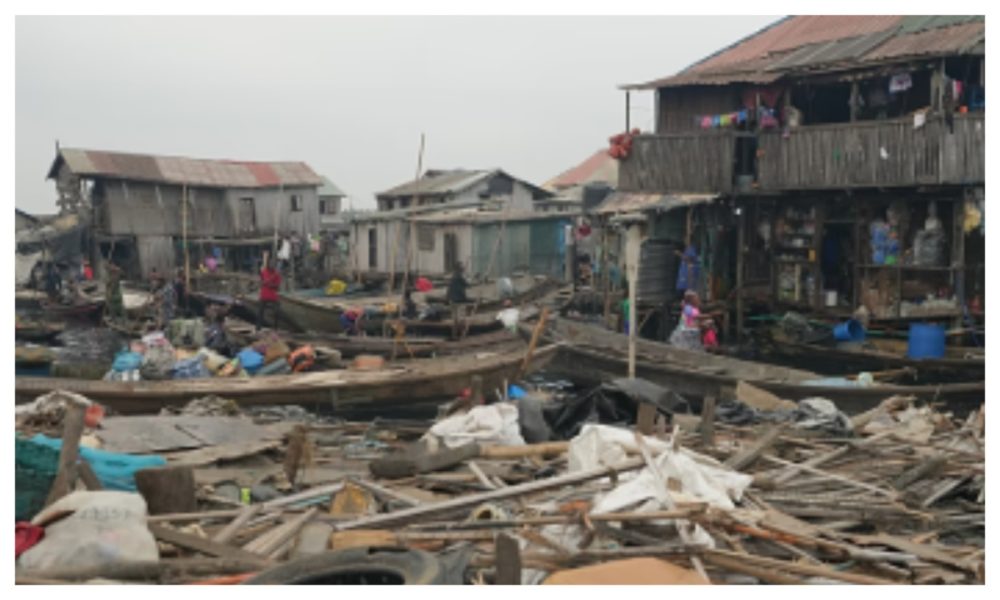
Makoko, a historic floating fishing community in Lagos, has been thrown into crisis following an ongoing demolition exercise by the Lagos State Government.
Thousands of residents, many of them women, children, widows and the elderly, have been rendered homeless, with families now sleeping inside canoes, under open skies and beside the lagoon.
Entire rows of wooden homes and shops have been pulled down, leaving behind broken planks, scattered household items and a community struggling to survive.
Makoko, often described as Africa’s largest floating slum, is home to fishermen, traders and artisans whose lives are intricately tied to the lagoon. For many residents, the demolition has not only erased their homes but also severed their means of survival.
Demolition that began quietly in December
Many residents told Bellnews that demolition activities started in parts of Makoko in December 2025, long before the issue gained public attention.
According to them, the operation expanded gradually, moving deeper into the community with little engagement or dialogue.
“They started from one side and kept moving,” Mr Sunday Adebayo said, a community elder who has lived in Makoko for over two decades.
“At first, we thought it would stop. Then it kept coming closer. Every day, one house after another. By January, it became massive. That was when we knew they wanted to wipe us out all in the name of development and infrastructure. Everything we own don finish,” he lamented.
Before the demolition, Makoko residents survived through fishing, trading and small-scale businesses run from their homes. Today, those means of survival are gone.
A 35-year-old fisherman, Oyomide, who spoke to DAILY POST, said he no longer knows how to feed his family.
“Na this water we dey take survive. I dey go fishing every morning, my wife dey smoke fish, we dey sell small-small. But when dem break house, everything go. My net spoil. My canoe nearly sink. Since that day, we never chop better food,” Oyomide said in pidgin English.
Another resident, a mother of four, said hunger has become their daily reality.
“Before, even if money no dey, we go find something chop. Now, nothing dey. No shop, no house, no work. Sometimes my children go sleep without food. As a mother, e dey pain me well well. Na every day I dey wake up for night dey cry, how I do I raise my children?” She said, fighting back tears.
Several residents said they lost cash savings, goods, fishing tools and household items during the demolition.
“Dem no even give us time. We no fit pack anything. My money wey I keep for house, my radio, my mattress, everything don go,” an elderly man said.
Many residents told Bellnews that they were born in Makoko, just like their parents and grandparents.
A 52-year-old fisherman, Balogun Adekunle, said his family has lived in the community for over four decades.
“My father lived here. I was born here. I grew up here. Now my children live here. For more than 40 years, this is the only home we’ve known,” he said.
Another resident, Mrs Bidemi, a widow with three children, said she has no other home.
“My husband died five years ago in a ghastly accident around Ikorodu. This house is all we have to survive. Now they’ve destroyed it. I’m alone, with no family support. Where am I supposed to go?” She cried.
Sleeping in canoes, drenched by rain
Since the demolition, displaced residents say the Lagos State Government has not provided any Internally Displaced Persons, IDPs, camp or temporary shelter.
When rain falls, they get drenched. When the sun comes out, there is no shade. At night, mosquitoes attack freely. At night, mothers hold their children tightly inside wooden boats.
“If rain fall, na rain go beat us. If sun hot, na sun go burn us. Mosquito no dey fear anybody. Dem break my shop. Everything wey I sell scatter. How my children wan chop?”
“In case you wey dey interview us now no know, no be only us dey suffer this thing. Ask plenty people dey wey no get house too. Maybe the government no want our progress, because how we won take start everything afresh now?” A young man told DAILY POST in Pidgin English.
A father of five said his children now fall sick regularly.
“My pikin dey cough every night. Cold dey worry dem. We no get roof again. I no know wetin go happen tomorrow,” he said quietly.
Some residents said they tried to seek refuge with relatives, but many have been turned away because they have no money to contribute to feeding.
“They came at night… they did not care who was inside”
One of the most disturbing allegations from residents is that demolition was sometimes carried out overnight, with little regard for human presence.
Multiple witnesses told DAILY POST that bulldozers moved in at odd hours, while residents were asleep.
“One night, around past midnight, we heard noise. Before we could understand what was happening, they were already pulling down houses. People were shouting. Children were crying. Nobody listened,” Mr Adekunle Hassan said.
Others alleged that some houses were set on fire, forcing occupants to flee.
“They burnt houses while people were still inside. We ran out with only the clothes on our bodies. My goods, my money, everything burned,” Mrs Blessing Okonkwo, an Igbo trader whose provision shop was destroyed alleged.
Children pulled out of school
One of the most painful consequences of the demolition is its impact on children.
Several parents told DAILY POST that their children have dropped out of school because they can no longer afford fees or transportation.
“My two children have stopped going to school. Their uniforms were destroyed. I have no money. How do I explain this to them?” Mrs Esther Ajayi said.
Teachers in nearby schools confirmed that attendance from Makoko pupils has dropped sharply since January.
Death, grief and unanswered questions
Beyond destruction of property, residents and civil society groups allege that at least 12 people have died in connection with the demolition exercise, some due to stress, others due to displacement-related illness and trauma.
Bellnews spoke with one Mr Ibrahim Lawal, whose younger brother reportedly died days after their home was demolished.
“My brother was healthy before. After they destroyed our house, he became sick. We had nowhere to sleep, no money for hospital. He died quietly. Is this development?,” He asked.
Another resident, Mrs Rukayat Bello, said her elderly mother collapsed shortly after their displacement.
“Shock killed her. She kept asking where we would sleep. She could not take it and she gave up peacefully,” Bello said.
While the Lagos State Government has not officially confirmed these deaths, residents insist that the human loss is real and devastating.
State Government insists: “Under high tension”
The Lagos State Government has maintained that the demolished structures were built under high-tension power lines, posing danger to lives.
Governor Babajide Sanwo-Olu said the buildings had been marked long ago and that residents were aware of the risks.
According to the governor, the exercise was carried out to prevent loss of lives and ensure safety.
He also stated that compensation was being arranged for affected residents, insisting that the government did not act suddenly.
However, several residents insist that many of the demolished structures were nowhere near high-tension power lines, contradicting the state government’s justification.
“How can they say it is about safety when they destroy places that are not even close?
“Some houses they destroyed are more than 500 metres away from the high-tension cables,” Mrs Funke Olawale, whose home and shop were demolished, counters the government claims.
Lagos State House of Assembly backs demolition despite protests
As the crisis intensified, the Lagos State House of Assembly took a hard political stance that enraged residents.
On 20 January 2026, lawmakers officially backed the controversial demolition, dismissing the repeated protests by Makoko residents and civil society groups.
The Chairman, House Committee on Information, Security and Strategy, Mr Stephen Ogundipe, said the exercise was a necessary step to safeguard the lives and property of residents in the state.
He said: “It is quite worrisome that we have ramshackle structures, sheds and shanties, especially along shorelines.
“The shorelines have turned to abodes of miscreants/street urchins, kidnappers, touts, street traders and hawkers, who often vandalise public utilities and attack innocent citizens.
“Although the demolition exercise may be painful for those affected, it is a necessary step to protect the larger society and uphold the rule of law.
“The government’s action reflects a commitment to preventing avoidable disasters and ensuring sustainable urban development.”
But residents saw it as a refusal to even listen to the voices of the people whose lives are being destroyed.
“We protested. We cried. We carried signs. We chanted that our homes matter. But the Assembly said development must continue, even if it kills us,” Mr Adewale, a youth leader in Makoko said.
Sanwo-Olu and Ezekwesili trade words
The demolition has sparked heated debate between government officials and national figures.
Former Education Minister, Oby Ezekwesili condemned the Lagos State Government’s actions, labelling them inhumane, unconstitutional and oppressive, especially because people were being displaced with no clear resettlement plan.
“What we are seeing is not safety. It is systemic violence against the poor.
“A government that changes its own rules to justify destruction of homes is not protecting citizens, it is betraying them,” she told journalists.
Governor Babajide Sanwo-Olu responded by defending the demolition, insisting it was a matter of public safety because structures were built under high-tension wires.
He also accused some NGOs of attempting to profit from the crisis by securing funds without effectively helping residents.
“Some groups are using this situation to attract dollars from overseas, then they don’t reach the people they claim to help. We are addressing safety, but others want to turn this into a business,” the governor said.
NGOs and civil rights advocates have strongly rejected the accusation, calling it an attempt to shift responsibility away from the government’s failure to provide humane alternatives.
Similarly, a Chieftain of the All Progressives Congress, APC, Joe Igbokwe, decried what he described as the continuous demolition of Igbo properties in Lagos, saying many lawful homeowners and business operators, particularly Igbo residents, have suffered similar demolitions without fair compensation.
In a post on his official Facebook page, Igbokwe said he has received numerous calls from fellow Igbo on how their houses are being demolished by officials of the state government.
“Hundreds of Igbo in Lagos have called me hours on end to complain of losing their houses. I am besieged everyday on this matter,” Igbokwe said.
According to him, Igbos are a strong force in the growth of Lagos, stating that “having been in Lagos for over 40 years, I know their humongous investment of Igbo in Lagos”.
“I am besieged. I am tired. I am exhausted. I am choked up. I am diminished. I am weak. I am under pressure everyday. I want a solution to this serious matter.
“I want bridges for understanding. I want bridges for mutual relationships. I want peaceful peace in Lagos. I want a new deal with Igbo and the Yorubas in Lagos”, he said.
The APC chieftain appealed to the state governor Babajide Sanwo-Olu to “look into the matter and find an amicable solution to the problem.”
A future filled with fear
As night falls on Makoko, fear hangs heavy in the air. Fishermen stare at the water, unsure if they can still fish. Traders wonder how to start again. Parents worry about how to feed their children the next day.
For now, Makoko remains a community floating between loss and uncertainty, a symbol of how development, when poorly handled, can destroy lives faster than it builds cities.