

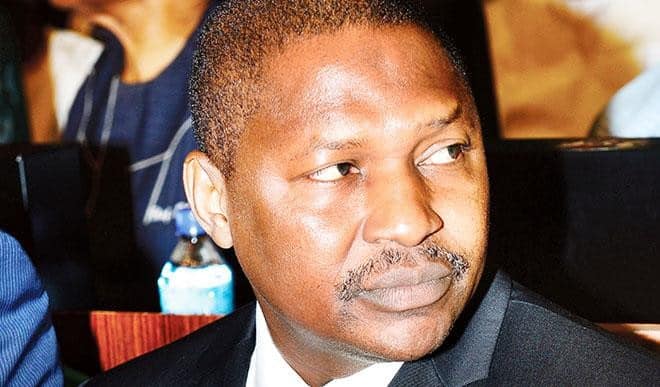
The Economic and Financial Crimes Commission (EFCC) has reportedly begun compiling charges against the former Attorney-General of the Federation (AGF) and Minister of Justice, Abubakar Malami (SAN), over alleged misappropriation of funds.
Malami, who has been in the anti-graft agency’s custody since Monday, has been granted administrative bail but remains detained due to ongoing verification of documents submitted to meet his bail conditions.
A source within the EFCC confirmed the development to Daily Trust, stressing that the commission is concluding its investigation and intends to arraign the former AGF in court soon.
“He has been granted an administrative bail but he’s with us because he’s yet to perfect his bail conditions. The documents he submitted for bail are still being scrutinised. Once that is done, he will go,” the source explained.
The source added, “Secondly, he would be arraigned in court as soon as we conclude our investigation. Charges are already being compiled against him. We’re not bittered. This is not persecution, we’re just doing our job.”
The current probe is reportedly revisiting a series of high-profile financial transactions that trailed Malami’s tenure, including those linked to the Abacha loot recovery and other controversial payments.
In the midst of the ongoing detention and compilation of charges, Malami issued a statement strongly defending his innocence and denying any involvement in terrorism financing or other crimes.
Malami stated “My attention has been drawn to a recent publication in which my name was mentioned in connection with allegations of terrorism financing and so-called ‘links’ to persons described as terror suspects or alleged financiers.
“I consider it necessary, in the interest of truth, justice and public record, to make the following clarifications.
First, I state clearly and unequivocally that I have never at any time been accused, invited, interrogated, investigated or charged by any security, law-enforcement, regulatory or intelligence agency—within or outside Nigeria—in respect of terrorism financing or any related offence.”
He added, “Secondly, even the retired military officer cited as the principal source in the said publication categorically admitted that he was not accusing me, or other named individuals, of financing terrorism.
“His own account, as reported, was limited to a vague assertion that certain suspects allegedly had some form of ‘business’ or ‘institutional’ relationship with various persons.
“That important clarification was, unfortunately, overshadowed by a headline and framing capable of misleading well-meaning members of the public into drawing inaccurate and damaging conclusions which was unfortunately politically manipulated by my political opponents to create mischievous insinuations implying my involvement in terrorism financing.
“Terrorism financing is a grave crime with devastating consequences for national security and human life. Any attempt—whether by direct allegation or indirect innuendo—to associate an individual with such an offence must be grounded in verifiable facts, due process and lawful findings, not in conjecture, speculation, or guilt by association.
“To suggest that lawful professional or institutional engagements can, without more, be read as evidence of terrorism financing is both mischievous and unjust.”