

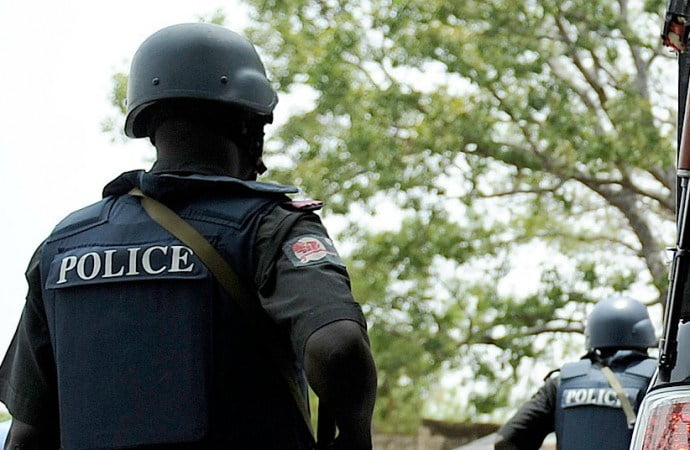
Angry Nigerians converged on the National Assembly to press for electoral transparency, but were met with a heavy deployment of soldiers and other combat-ready security operatives, creating a battle-ready atmosphere.
Tension heightened on Tuesday at the main gate of the National Assembly complex in Abuja as protesters under the
#OccupyNASS movement gathered to demand a mandatory electronic transmission of election results.
Angry Nigerians converged on the National Assembly to press for electoral transparency, but were met with a heavy deployment of soldiers and other combat-ready security operatives, creating a battle-ready atmosphere.
Bellnews observed that the number of security personnel deployed to the protest venue had increased significantly compared to the first day of the demonstration, raising concerns among protesters about the necessity of such force at what they described as a peaceful civic action.
The protesters questioned the rationale behind the massive security presence, insisting that their protest remained peaceful and constitutionally protected.
Security agencies deployed to the area include the Nigerian Army (Guards Brigade), Nigeria Police Force, Department of State Services (DSS), Nigeria Intelligence Agency (NIA), Nigerian Air Force, Nigerian Navy, Nigeria Immigration Service (NIS), Nigeria Security and Civil Defence Corps (NSCDC), Federal Road Safety Corps (FRSC), among others.
Several protesters and civil society activists criticised the heavy militarisation of the protest, describing it as unwarranted, undemocratic, and unconstitutional.
Speaking at the protest ground, human rights activist Aisha Yesufu condemned the deployment, describing it as an aberration and a sign of poor democratic culture.
“Today, again, we are seeing heavily armed security operatives whether battalions or otherwise brandishing tear gas canisters and life-threatening weapons. We even saw the military deployed earlier today,” she said.
Yesufu questioned the presence of the military at the protest, asking, “Why is the Nigerian military here when the country’s territorial integrity is under serious threat elsewhere?”
She accused the Nigerian Police Force of failing in its constitutional responsibility to manage internal security, warning that the repeated deployment of the military and other armed agencies against civilians amounted to an erosion of constitutional order.
“The police are supposed to be in charge of internal security. But instead of reform when they fail, we see the military, DSS, and other armed forces being deployed against unarmed citizens,” she stated.
Addressing soldiers at the protest venue, Yesufu warned that such deployments were unconstitutional and outside the military’s mandate.
“To every soldier brought here today, know that you are here unconstitutionally. Your job description does not include standing against citizens exercising their right to protest,” she said.
She recalled previous incidents at Lekki in Lagos where unarmed demonstrators were allegedly killed while protesting peacefully, urging security operatives to avoid repeating history.
“Before you pull that trigger or carry out that order, ask yourself whether it is constitutional or unconstitutional,” she cautioned.
The activist also criticised the government’s approach to insecurity, alleging that soldiers were being deployed against civilians while terrorists continued to operate freely in other parts of the country.
“Our soldiers are being used in the wrong places, while terrorists mock the country daily. Citizens are not the enemy,” she said.
According to the protesters, their demand remains simple and unchanged: a transparent, credible, and mandatory electronic transmission of election results.
“All Nigerians are asking for is electronic transmission of results, nothing more,” the protesters said.
Meanwhile at the time of this report the protest remained largely peaceful, with demonstrators awaiting the arrival of lawmakers who were having an emergency sitting to address their demands.