

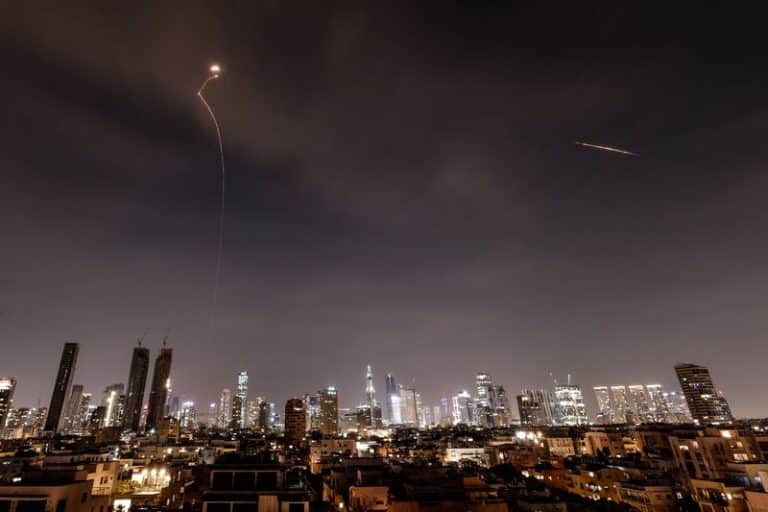
Iran on Wednesday launched a new barrage of missiles across parts of the Middle East despite signals from United States President, Donald Trump, that Washington was seeking negotiations with Tehran.
The fresh strikes came as global markets showed signs of stabilising after weeks of tension, with oil prices falling and Asian stocks rising amid hopes of possible de-escalation following nearly four weeks of conflict.
Speaking to reporters at the Oval Office, Trump suggested that diplomatic engagement with Iran was underway.
The US president said, “We’re in negotiations right now.
“They did something yesterday that was amazing actually. They gave us a present and the present arrived today. And it was a very big present worth a tremendous amount of money.
“That meant one thing to me, we’re dealing with the right people.”
Trump did not provide further details but indicated the development was linked to the Strait of Hormuz, a critical global oil shipping route that Iran has largely blockaded in retaliation for US and Israeli attacks.
Iranian officials have yet to confirm any formal negotiations.
However, The New York Times reported that Washington had sent a 15-point proposal to Iran through Pakistan, which has offered to mediate between the two countries.
It remains unclear whether Israel, which has been carrying out strikes on Iran and the Hezbollah militant group in Lebanon, is involved in or aware of the proposed diplomatic plan.
Despite the diplomatic signals, Iran’s Revolutionary Guards said they had launched a new wave of missiles targeting Israel and military facilities hosting US forces in Kuwait, Jordan, and Bahrain.
Iran has continued retaliatory attacks against Israel and Gulf countries it accuses of assisting US military operations.
Drones Strike Infrastructure In Gulf States
Authorities in Kuwait said drones struck a fuel tank at Kuwait International Airport, causing a fire and what officials described as limited damage.
In Bahrain, the interior ministry confirmed that air raid sirens were activated, while Jordanian authorities reported shrapnel falling near the capital, Amman, without causing casualties.
Saudi Arabia also reported intercepting at least four drones in the eastern part of the kingdom.
Israel said it was launching further attacks against what it described as “infrastructure of the Iranian terror regime” following the latest missile launches.
Iran, meanwhile, accused Israel of carrying out another strike on the Bushehr nuclear plant, a civilian facility.
Residents in Tehran described living under constant threat.
“The sounds, the explosions, the missiles, they are part of our daily life now,” a 35-year-old woman told AFP by telephone.
Fighting Spreads To Lebanon
The conflict has also intensified in Lebanon, where state media reported that Israeli strikes killed six people in a town and a Palestinian refugee camp near Sidon.
Israel has expanded its military campaign against Hezbollah, saying it intends to take control of areas in southern Lebanon up to the Litani River, about 30 kilometres from the border.
Global attention remains focused on the Strait of Hormuz, through which about one-fifth of the world’s crude oil passes.
Iran has assured the International Maritime Organisation that “non-hostile vessels” will be allowed safe passage through the waterway.
However, Tehran warned that ships linked to “the aggressor parties — namely the United States and the Israeli regime” would not be allowed to transit the strait.
Signs of possible diplomatic progress pushed global oil prices lower, with benchmark crude dropping by more than six per cent.
The price decline followed weeks of rising energy costs triggered by the conflict, which has also driven fuel prices higher in the United States.
Meanwhile, French President, Emmanuel Macron, urged Iran to take negotiations seriously.
“I called on Iran to engage in good faith in negotiations,” Macron wrote on 𝕏 after speaking with Iranian President Masoud Pezeshkian.