

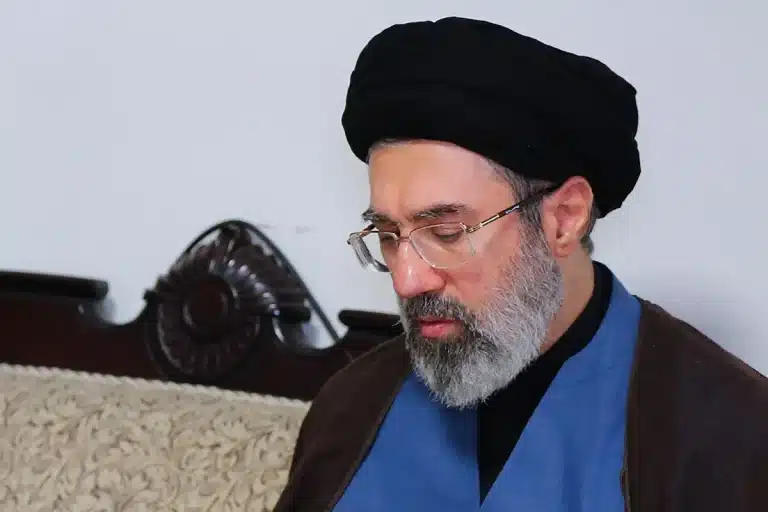
Mojtaba Khamenei, the son of Iran’s slain supreme leader Ayatollah Ali KhameneiMojtaba Khamenei, the son of Iran’s slain supreme leader Ayatollah Ali Khamenei
Mojtaba Khamenei, the son of the late Iranian supreme leader, Ali Khamenei, has been appointed as the new head of the Islamic Republic.
The announcement was made shortly after midnight on Monday by the Assembly of Experts, the influential clerical body responsible for selecting Iran’s supreme leader.
The body said it had reached its decision following internal deliberations on who should succeed the long-serving leader after his death.
According to the Assembly of Experts, several figures were considered for the position.
Among the reported contenders were Alireza Arafi, hardline cleric Mohsen Araki, and Hassan Khomeini, the grandson of the founder of the Islamic Republic.
However, the assembly ultimately selected Mojtaba Khamenei, 56, marking a rare hereditary transition within Iran’s political system.
The development is notable because the 1979 Islamic Revolution ended centuries of monarchical rule under the Shah and was built on principles that rejected hereditary leadership.
Mojtaba Khamenei was born on September 8, 1969, in Mashhad, one of Iran’s holiest cities.
He is one of six children of Ali Khamenei, who led Iran as supreme leader from 1989 until his death in 2026.
Despite maintaining a relatively low public profile, Mojtaba has long been seen as a powerful figure within Iran’s political system.
His influence, analysts say, often operated quietly behind the scenes.
The cleric is widely regarded as having strong connections with the Islamic Revolutionary Guard Corps, the powerful ideological arm of Iran’s military.
Those ties date back to the closing years of the Iran–Iraq War, during which Mojtaba reportedly served in a combat unit.
He is also known for maintaining close relationships with conservative factions within the Iranian political establishment.
In 2019, the United States Department of the Treasury imposed sanctions on Mojtaba during the administration of Donald Trump.
The US accused him of representing the authority of the supreme leader despite never holding an elected government position.
The Treasury alleged that he worked closely with Iranian security forces to advance policies associated with his father’s leadership.
Opponents have also accused him of involvement in the crackdown that followed the disputed re-election of Mahmoud Ahmadinejad in 2009, which triggered widespread protests across the country.
Investigations cited by Western intelligence sources have also alleged that Mojtaba accumulated wealth estimated at more than $100 million through complex international investments.
Reports suggested that oil-related revenues were channelled into luxury real estate in the United Kingdom, hotels in Europe and property investments in Dubai through offshore shell companies.
Iranian authorities have not publicly confirmed such allegations.
On the religious front, Mojtaba Khamenei studied Islamic theology in Qom, one of the world’s most important centres of Shiite scholarship.
He later taught religious studies there and attained the clerical rank of Hujjat al-Islam, a mid-level clerical title below the rank of Ayatollah.
His father and the founder of the Islamic Republic, Ruhollah Khomeini, both held the higher title of Ayatollah.
Iranian authorities said Mojtaba’s wife, Zahra Haddad-Adel, the daughter of a former speaker of parliament, was also killed during the US-Israeli airstrikes that claimed the life of Ali Khamenei.
The strikes targeted leadership sites in Tehran, escalating tensions across the Middle East.
Following the leadership announcement, Israeli authorities issued a warning to the new supreme leader and those who selected him.
Officials said “the hand of the State of Israel will continue to follow any successor and anyone who seeks to appoint a successor.”
The statement signalled that the regional conflict that led to the killing of Ali Khamenei may continue to shape Iran’s political future.
The Assembly of Experts, which consists of 88 clerics elected every eight years, has previously overseen only one leadership transition.
That occurred in 1989, when Ali Khamenei was selected to succeed Ruhollah Khomeini following the founder’s death.
Mojtaba Khamenei’s appointment therefore marks only the second leadership transition in the Islamic Republic’s modern history, at a time of heightened geopolitical tension in the region.